



The Cremona-based company stands alongside livestock farmers in the assessment, design, and construction of biogas and biomethane components and plants, whether newly built or converted from existing facilities.
For every livestock farming business, the construction of a biogas plant has long represented an important and vital source of additional income, ensuring the necessary economic sustainability while also providing a means to enhance the value of livestock effluents and reduce environmental impact.
With the recent approval of the “DL Bollette” decree (measures aimed at reducing system charges arising from bioenergy), the mechanisms governing guaranteed minimum prices (Pmg) for bioliquid, biogas, and biomass plants have been updated.
The decree also defines the maximum number of incentivized operating hours per year and introduces commitments related to the conversion of existing plants. It is therefore essential for every livestock farming business to carefully evaluate whether to build a new plant and/or continue operations, as well as to determine which technological and economic solution is the most feasible and advantageous.
For greater clarity, it should be noted, for example, that for existing biogas plants with a capacity exceeding 300 kW, access to incentives beyond 2030 will depend on the decision to convert them to biomethane. Smaller plants with a capacity below 300 kW, on the other hand, will be able to maintain guaranteed minimum prices until 2037 even without conversion.
Opportunities to Evaluate
At the same time, the Ministry of the Environment and Energy Security has committed to launching the process leading to a new biomethane decree, although the timing and implementation details have yet to be defined.
It is quite evident that the legislator’s intention is to promote the development of these facilities, also through the proposed incentives and capital grants for grid connection costs, REMI stations, and booster compressors, as well as through the implementation of bidirectional distribution networks. These measures will effectively give the vast majority of livestock farming businesses the opportunity to produce and sell biomethane.
For smaller livestock farming operations, the possibility of building biogas plants for the production of electrical and thermal energy with a maximum capacity of 300 kW remains highly relevant, with a guaranteed tariff of €0.233/kWh for a period of 20 years.
Reliability and Experience
Considering that every livestock farming business is unique and cannot be replicated when it comes to investment decisions, it is important to analyze all of its specific characteristics and challenges in order to adopt the most suitable technical and economic solutions.
Increasingly, it is necessary to analyze and coordinate the various areas of expertise involved in the planning and construction of biogas and/or biomethane plants, including sizing, agricultural and livestock management aspects, logistics, engineering, agronomy, organization, and operations management. These are often complex decisions that will significantly influence the company’s future activities and development. For this reason, relying on a partner with a proven tradition of reliability and expertise is essential.
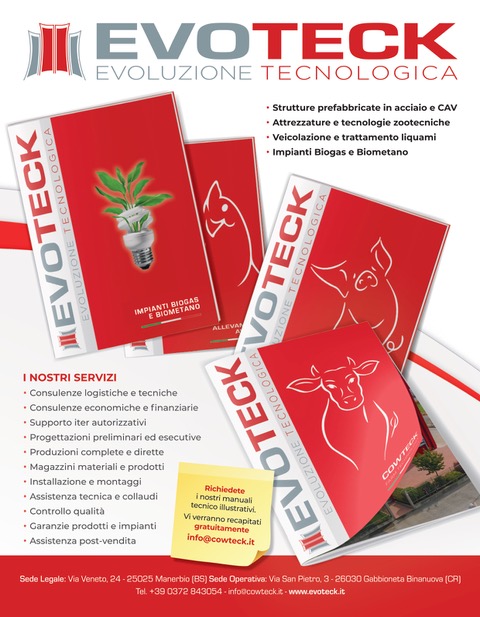
With more than 20 years of market presence and highly qualified experience at both national and international levels in the livestock and renewable energy sectors, Evoteck guarantees quality, specialization, safety, and reliability. Evoteck aims to support operators in the livestock sector through the assessment, study, design, and construction of both biogas and biomethane components and plants, including new projects as well as revamping and conversion of existing facilities, in order to ensure the best logistical and technical choices and contribute to enhancing the competitiveness of Italian livestock farming.
In Conclusion
The Evoteck technical team will be pleased to evaluate your business operations together with you, analyze your needs, and provide non-binding advice on the most suitable plant engineering and sizing solutions. The team can also prepare useful comparative business plans in order to support you in choosing the most economically advantageous solution.